Monday, July 06, 2009

Robinsonade

Add this one to the list of classic literature I have never read: Robinson Crusoe is a book I've never opened, and I'm sure I've passed it by numerous times during my book-shopping habits. Not that it never would have appealed to me. I'd bet 10-year-old me, who enjoyed Robert Louis Stevenson and Charles Dickens, would probably have liked it a lot.

The reason it hasn't jumped out at me as a book requiring my attention may be the huge amount of artistic homage to Defoe's 18th century novel. Lost in Space, Swiss Family Robinson, Gilligan's Island: people are constantly ending up on uncivilized, ignored islands, left to fend for themselves. Men imagine each other are some form of beef-based junk food. Tom Hanks names a ball Wilson, which has become a part of American culture as the best name for a self-named friend. This continual reference to Robinson Crusoe even has its own, rather obvious and clumsy name: Robinsonade. The Germans loved the Robinsonade genre more than anyone else during the 18th century, but that doesn't mean they were necessarily good at it, according to The History of German Literature:
[Robinson Crusoe] appeared in a German translation in 1721, and elicited in Germany, as well as throughout Europe, the greatest admiration and a countless host of imitators. Between 1722 and 1755 more than forty Robinsons appeared in Germany, and were read with frantic eagerness. There were the German Robinson, the Italian Robinson, the clerical ditto; the Saxon, the Silesian, the Franconian Robinson; two Westphalian Robinsons at once; the moral, the medicinal, the invisible Robinson; and even the Bohemian Robinson. Then there was the European Robinsonetta: "Miss Robinson, or the cunning young maid;" "Robunse, with her daughter, Robinschen," and so forth. The books are generally worse than the titles.
We Americans lay claim to a genre called "Westerns" that is just about as full of waste as the German Robinsonade genre, so I can't complain too much. Even as a genre, "western" tosses a wider net , in terms of geography and characters, than the "robinson-crusoe" genre. A Robinsonade needs a main character, a one-way mode of transportation, and a civilization-free destination — the rest tends to lean on the level on ingenuity the character has, on on what aspects of civilization they can do without. For as narrow that view is, we've seen a couple hundred years of revamping and re-processing that same story in a myriad of styles, covering wide-ranging genres from contemporary fiction to sci-fi. To see more, the University of Florida's Digital Collections has a whole section on the Robinsonade genre.

Labels: , ,

Wednesday, July 01, 2009

Acquisitions: Speer Ammunition Manual

While rummaging this past weekend, we happened across a little bundle of hand-reloading resources. The rummage sale was rife with western novels, a few WWII novels, and the host looked like he had rode more than his share of motorcycles in his life, so it isn't a large leap to figure he made good use of these books during his hobby time. I have no interest in hunting, and only a passing interest in gunplay (I had fun skeet shooting once), so these books aren't for me. Although, the detailed mechanics therein do appeal to the geek in me: who knew bullets were so complex? No, I can't talk myself into keeping yet another book of statistics of no use to me: each one is for sale over at WeHaveYourCollectibles.com.

Labels: , ,

Tuesday, June 30, 2009

Flame and Fur, Fangs and Wicker

As we've seen, Lyttle-Lytton released their results recently, but so has the Big Boy of these competitions, the Bulwer-Lytton Fiction Contest. The 2009 Bulwer-Lytton Best In Show is nautically-themed as well: "Folks say that if you listen real close at the height of the full moon, when the wind is blowin' off Nantucket Sound from the nor' east and the dogs are howlin' for no earthly reason, you can hear the awful screams of the crew of the "Ellie May," a sturdy whaler Captained by John McTavish; for it was on just such a night when the rum was flowin' and, Davey Jones be damned, big John brought his men on deck for the first of several screaming contests."

Once a strong and respected genre, the seafaring novel seems to have fallen from favor with the literary illuminati. Or, maybe nautical authors are simply lacking in skill and quality; the lack of opportunities to actually crew a square-rigged ship may mean too much is left to the imagination. I mean, look at this other example I found online: "Here have I been unconsciously toiling, not pleasuring, - aye, and ignorantly smoking to windward all the while; to windward, and with such nervous whiffs, as if, like the dying whale, my final jets were the strongest and fullest of trouble. What business have I with this pipe? This thing that is meant for sereneness, to send up mild white vapors among mild white hairs, not among torn iron-grey locks like mine. I'll smoke no more - " I mean, who does this "Herman Melville" think he is, writing a book about whaling?

Alas, such dreck isn't acceptable to the Bulwer-Lytton contest; being previously-published, the B-L won't accept it. Both contests are parodies of horrible writing, which — as any parodist will tell you — requires nearly as much talent as being a novelist in entirety. B-L does recognize that horrible writing didn't stop in the 19th century with the original Bulwer-Lytton and that hack Melville: they happily show off some recent examples of the obfuscated and poorly done metaphors.

Labels: , , ,

Sunday, June 28, 2009

Briskly, Pants On Her Legs

The Lyttle-Lytton contest for unintentionally-funny literature has released their 2009 results — the winner, it seems, was the nautically-themed "The mighty frigate Indestructible rounded the Horn of Africa and lurched east'ard." Interestingly, at least according to the internet, "east'ard" is an extremely rare word, although it was featured in the title of a 1936 Time magazine story. This, sadly, lends no credibility to the Lyttle-Lytton winner.

Labels: , , ,

Thursday, June 25, 2009

Naked Lunch, Disturbing Literature

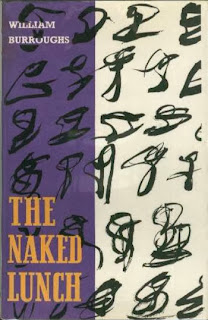
Naked Lunch, William Burrough's revered drug-fueled tale of anal sex, turns 50 this year, having now addled the brains of more than one generation. I attempted to read this during my twenties, and the copy still sits on my shelf, only the first twenty or so pages with any discernible evidence of having been read. Couldn't make it through the book; it made me feel like all the Sam Shepard and Samuel Beckett I read during my theatre years did — that there was some huge joke on me, or on everybody, but I was the only one to recognize that the jumble of overwrought symbolism really meant far less than the literati would have you believe. The absurdist era never really appealed to me, no matter how much I tried, I just couldn't enjoy any of it, and it seems that none was ment to be enjoyed, but to pondered.

Burrough's masterpiece fills the #8 spot in PopCrunch's list of The 10 Most Disturbing Books Of All Time. Before I even opened the link I knew Naked Lunch had to be somewhere on the list, but I was curious about the rest. My greatest surprise was the number of disturbing books that had been made into movies: Blindness, Requiem for a Dream, American Psycho. What didn't surprise me much is that I hadn't read any of the books. I guess I'm too much of an optimist, that overly depressing and violent books really don't appeal to me. Maybe I'm missing out — many of these books also show up on others' lists of great works of modern literature, so it might be time to try one out. Naked Lunch is still off my list; I don't care if it has lasted through 50 years of literary acclaim, I'm not sure I could get any further than I had already read.

Via, Via.

Labels: ,

Wednesday, June 24, 2009

Body Writing, Esquire And Others

I'm actually an Esquire subscriber — some free-offer thing — but after the first few issues I was actually rather impressed with the magazine. As you might expect, the most recent cover, which, ahem, seems more Playboy than Esquire, doesn't hurt my opinion of the magazine, either. The feature of the issue is a new short story by Stephen King, and the first few lines are painted on the eye-appealing naked body of supermodel Bar Refaeli:

Beauty of the female form has long been a feature of the covers of magazines (Elle, Cosmopolitan, et al are some of the worst, or best, culprits, frankly). The women's website Lemondrop felt that hot men were rather left out in the deal, so they took their favorite literature and "painted" it on to some hot men. Soccer expert David Beckham, honoring Are You There God, It's Me Margaret?, is some funny stuff right there:

Labels: , ,

Tuesday, June 23, 2009

Acquisitions: Hansi's New Life


Lastly, a book I picked up more for its internet notoriety than anything. I often see the comic book Hansi: The Girl who Loved the Swastika pop up online as a non sequitur, "WTF?" contribution to the world of online content because the cover looks so "Yay, Nazis!". I actually own a copy: I had bought it long before it was appearing online. The comic was published by a Christian comic house, and is decidedly anti-Nazi throughout, so the funny cover is about the biggest chortle in the funnybook. What few people recognize is that the comic was based on an autobiographical novel by the real "Hansi," Maria Anne Hirschmann, that was first issued with the same title as the comic, but was later revised as "The Girl Who Left the Swastika," probably to cut back on the amusement of loving Nazi symbols. The book above, I believe, is Hirschmann's second book, Hansi's New Life. If you don't believe me that Hirschmann is the real Hansi, here's proof, taped in the front cover:


Yes, folks, that's the real Hansi, sitting in the Fargo Holiday Inn, sometime in the 1980s. Strangely, despite the photo, the book is not autographed, which may mean the book was purchased after the appearance. I currently own a copy of the comic, the original biography, and now the sequel, putting me well on the way to a complete swastika-loving Hansi library.

Labels: , ,

Monday, June 22, 2009

Review: West On The 49th Parallel

Early in most American's education, we learn that the 49th parallel of latitude divides the United States from Canada, the longest undefended international border in the world. On a globe or map, it isn't difficult to draw the line and say, "there you go," that's U.S., that's Canada. On the ground, however, it is a difficult prospect. A latitudinal line is a cartographic construct: the border isn't the middle of a river, or the edge of an ocean, or the peaks of a mountain. Those markers can be seen from the ground, while the 49th parallel can not. John E Parson's book, West on the 49th Parallel: Red River to the Rockies, 1873-1876 documents the first successful and somewhat accurate attempt to mark the line along the borders of Minnesota, North Dakota, and Montana. There had been previous attempts to mark the border, with great inaccuracies, but the 1873 product was a joint venture between the British (who held Canada at the time) and U.S. governments. The main method of measuring latitude at the time was by star observations, which at the time had an accuracy within a few dozen feet (amazing, on par with GPS and definitely better than Google Maps' markers), but required a staff of astronomers and mathematicians to correctly interpret. Toss in security to help against the Indian threat, generals and majors to be in charge, the short seasons in which to do the work, and general weirdness involved in being in so remote an area all make for a less than boring adventure.

The book itself, unfortunately, is very dry; it does, however, include quite a bit of dry humor along with the boring parts. The actual process of figuring out the position of the 49th parallel is minor, compared to the pages of anecdotes about life for the crews in charge of the project. You hear of the guy who managed to shoot himself—twice—while on the job, the parties held at remote forts for various holidays, the wild dog conscripted to help pull sleds, the Fenian cook who insisted his innocence but ended up in jail for violent crime before he could even set out with the crew…it's like Best of the West hooked up with Deadwood for a little political cartography. I like Red River history, so the places and situations are familiar to me, but the book won't be for everyone. As a historial reference, it does well with facts and accuracy, but the dryness makes it a less-than-ideal piece of historic entertainment. What somebody needs to do is adapt it to a screenplay; the goofiness of the characters definitely entertains.

West on the 49th Parallel: Red River to the Rockies, 1873-1876
by John E Parsons
Originally published 1963

Labels: , ,

Sunday, June 21, 2009

Father's Day Faux Pas

Happy Father's Day everyone! As a dad and a reader, I completely understand books as a way to reward Dad for another year as provider, car-repair-advisor, and master barbecuer (if you don't mind a little stereotyping). Better than another tie or humorous t-shirt anyway. A book I wouldn't recommend is, well, anything to do with Josef Fritzl, the psycho parent who kept his daughter in his basement for 24 years and enjoyed …"intimate"… time with her. That's just my recommendations, however — over in the U.K., however, retail giant Tesco apparently didn't have a problem with daughters buying The Crimes of Josef Fritzl for this Father's Day, until it was brought to their attention and an apology was drafted. From first-hand accounts over at Fark, the book was on a specific Father's Day display in the stores — much to the dismay of sharp-eyed shoppers, but what about those shelf-stockers who put the books out? This didn't happen just at Tesco, but also at W.H. Smith, a large bookselling chain in the U.K. I can understand big-box retailer drones not watching what they're tossing on the shelves, but I'd expect more from a retailer who prides themselves on being a leading example of the book retail industry.

The Daily Mail shows the book on the display, bearing the same "half price" sticker as the rest of the books on the promotional displays, so it wasn't a case of "oops, wrong book on the shelves." Special displays are often paid spots, akin to advertising, where a publisher ensures their big promotions are on the endcap or the table at the entryway where they're likely to get more attention. I dug around to see if Smith's was the one in charge of Tesco's book section, like the K-Mart/Waldenbooks arrangement, but everything I found called the two retailers competitors. Now, I'd hope Harper Collins would be smart enough not to specifically recommend this book for Father's Day, but I find it very suspicious that two different retailers, without shared corporate control, would place the same inappropriate book in the Father's Day display. Somebody — publisher, distributor, retailer — got in their head that they needed a recent, hot-button, True Crime title in their dad's display, because dad's like true crime books, you see, so what have we got? Aw, the book is even about a dad, that works great!

Labels: , , ,

Friday, June 19, 2009

JD Salinger: Unmasked!

J.D. Salinger wrote Catcher in the Rye over fifty years ago, but while his book has been in the public eye for the better part of a century, the author has been famously reclusive. Salinger has been in the news lately, however, trying to block a book from using his copyrighted characters without his permission, but he still hasn't made any public appearances. AbeBooks has a Salinger retrospective, for people following the story but only familiar with Salinger through Catcher, and they include this "back of a milk carton" look at how Salinger might appear today:

The artist's rendition looks a bit younger than eighty-something; for a more recent look, which purports to be an actual photo of the author, check out his biography's cover:

I'll bet literary historians are hoping this goes to court: it may all be an elaborate scheme to get Salinger to appear as a witness, on the stand, for all to bask in his visage after so many years. Won't everybody be surprised when he shows up looking like Thomas Pynchon on The Simpsons?

Labels: ,